Monday, April 18, 2011

Chapter 10: The Southern Coastlands: On the Subtropical Margin

Chapter 10:  The Southern Coastlands:  On the Subtropical Margin

Yes, Mobile is located in the Southern region, but its microregion is the Southern Coastlands, the area discussed in Chapter 10.  I have addressed Mobile's subtropical, humid climate that is very different from the rest of our country in previous posts.  This climate not only extends the growing season, it also attracts new residents and visitors.  Unlike its neighboring state of Florida, Mobile does not have a large retirement age group.  In fact, the median age is only 34.3.  If you take a short trip across Mobile Bay however, you will find one of the nicest and most unusual retirement communities in the US in Fairhope, AL.  Although it is located in another county (Baldwin), it is only a half hour drive from downtown Mobile.  Retirees are attracted to this little city because of the temperate climate and low crime rate.  With a population of 14,000, retirees make up over 35% of the population.  I spent much time going “across the Bay” to visit my grandfather (PawPaw) and strolling the downtown streets for beignets and shopping in the quaint stores.  If you drive a little further down to Gulf Shores, AL, located on the Gulf of Mexico, they even have a term for their retired visitors – “Snowbirds.”  These retired Baby Boomers hail from the northern and Midwestern states as well as Canada.  Usually arriving in October, they escape the harsh winter conditions of the north to enjoy a mild winter along the Gulf Coast in condos, RVs or retirement communities.  Hard numbers on how many Snowbirds winter on the Gulf Coast are impossible to find, some estimate more than 100,000 winter along the northern Gulf Coast and numbers are expected to increase over the next decade. 

Delicious beignets from Fairhope I enjoyed over the Christmas holidays!


A retirement community in Fairhope, AL


While the weather, especially in winter months, is very enjoyable, there is a downside to all of that hot, humid air along the Gulf Coast – hurricanes.  When discussing the damage done by Hurricane Katrina, most of the talk covers New Orleans and some about Mississippi, but Alabama suffered greatly from this storm.  Alabama suffered widespread, moderate to heavy damage caused by hurricane-force winds, flooding by a storm tide of 14–18 feet, and tornadoes.  Massive damage occurred along coastal areas, pushing small ships and oil rigs ashore, flooding fishing areas with dozens of shrimp boats, destroying marinas plus hundreds of boardwalks, and swamping beachfront homes or hotels, with widespread tree damage and roofs or shingles torn off. Afterward, 22 counties in Alabama were declared disaster areas for Federal assistance, spanning a 400-mile region.  Mobile Bay spilled into downtown Mobile to the depth of 2–6 feet. A flotel (floating habitat used by oil platform crews) broke loose of its moorings and slammed into the Cochrane-Africatown USA Bridge, the bridge damage was later found not to be critical but in the meantime its traffic was reduced from four lanes to two. There was cause for concern because the bridge, in conjunction with underwater tunnels, is a part of the I-10 Hazardous Materials route across the Mobile River. The Battleship Parkway crossing Mobile Bay was also closed before the storm and was completely submerged during the hurricane. Many coastal homes south of the Point Clear area were severely damaged, flooded, or swept away.  Damage was quite heavy in coastal Alabama, including significant structural damage to buildings. Bayou La Batre, a fishing town 15 minutes from my house in Mobile, sustained significant damage to its infrastructure and fishing fleet. It was the focal point of public attention given to Alabama in the aftermath of the storm. On Sunday, September 4, 2005, U.S. Secretary of State Condoleezza Rice visited a community center in Bayou La Batre and surveyed storm damage with Alabama Governor Bob Riley. My grandmother’s (Nannie) house in the Bayou was blown away from this powerful hurricane.  I was not a resident of Mobile when Katrina hit, but I did visit the Bayou in October of 2005.  The devastation was unlike anything I’ve ever seen in person.  Hundreds of shrimp boats were stacked up on top of each other, 50 yards offshore.  It was such a surreal experience that I didn’t even think to take a picture.  The picture below is one I found on the web, but it does no justice to what I saw a month after the disaster. 


Hurricane Katrina as a Category 5


Shrimp boats in Bayou La Batre, AL after Hurricane Katrina


Sources:


Sunday, March 20, 2011

Chapter 9: The Changing South

Mobile is part of the Changing South, more specifically the Southern Coastlands described in the next chapter. Growing up a Southerner, I can attest to the rich culture and the pride Southerners feel about their region. Although there is an overall general “southern pride,” there is much diversity within the Southern region. When I think of the South, I think of the states Alabama, Mississippi, Louisiana, Georgia, Tennessee and the Carolinas. Kentucky, Arkansas, Texas and Virginia are also considered part of the region, but ask any Mobilian or Alabamian and they will tell you differently. I attribute this to the strong differences between the sub-regions. Although there are differences between Mobile in the Southern Coastlands and say Atlanta in the Piedmont region, we all share commonality and pride in being Southern.

Alabama State Flag
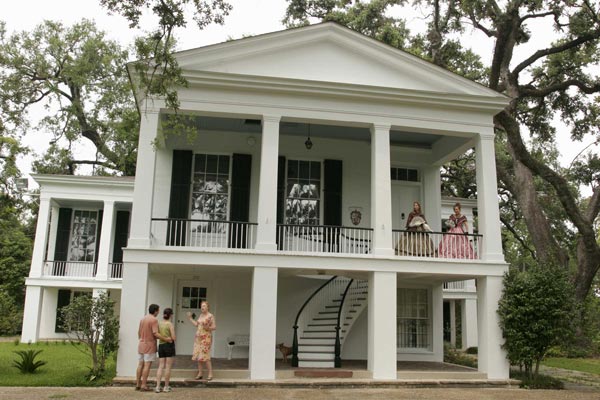
When one thinks of the Old South, plantations dominate public thought. Crops like short staple cotton did well in Mobile - in fact, I had a cotton field across the street from my house growing up - but other southern crop staples like indigo, tobacco and sugar cane did not do well. These plantations were almost always located along rivers so they could transport the raw cotton faster and more cost effectively. The Alabama River was heavily used as it flowed into the port of Mobile. From Mobile, the cotton was shipped to New England and European textile factories.
Oakleigh Mansion, a famous plantation house in Mobile

Vessel License for the Clotilde, circa 1855

Plantations and the South cannot be discussed without mentioning slaves. Because large-scale plantation production required a large amount of labor, the number of slaves in the state grew from almost 48,000 in 1820, to 435,000 in 1860. Most of these slaves worked in cotton production. Although there were plantations in Mobile, the city is more known for being the port from which many of the slaves came through and was the slave trading capital of the state until 1850. In fact, the last known shipment of slaves was brought to Mobile illegally in 1860, more than 50 years after the slave trade had been declared illegal.


Sources:
http://www.encyclopediaofalabama.org/face/Article.jsp?id=h-1832
http://en.wikipedia.org/wiki/Mobile_(AL)

http://en.wikipedia.org/wiki/Africatown

Chapter 8: Appalachia and Ozarks

At first glance, Appalachia and the South have similar characteristics. Both have good land for agricultural purposes, but Appalachian land is better suited for smaller farming. Both had slower development of manufacturing, but Mobile’s urban development has been more successful than most of Appalachia. While Mobile had many immigrants including France, Britain and Spain at the onset, Appalachia was settled mostly by the Germans and Scots-Irish, establishing its Anglo-Saxon population that endures to this day.
Appalachia had good land for small-scale farming, but poorly suited for large-scale agriculture compared to land in the South. This region continued to focus on agriculture long after manufacturing and urban living enveloped the rest of the country. Appalachia had few products to sell and discouraged development. In many small Appalachian counties the black populations are very small. Few new immigrants ever settled here because of little urban development, no antebellum plantation economy like the South and had limited agricultural land. Appalachia remained unchanged in a nation where immigration, education and commerce were the norm.

Tennessee farm
Like Mobile, Appalachia is mostly Protestant, but is mostly Anglo-Saxon and white, whereas Mobile is about half white and half black, as mentioned in a previous post. In fact, Appalachia is the nation’s largest predominantly white, low-income region according to the book. Like Mobile, the people of Appalachia are conservative both politically and religiously. Appalachia is also included in the Bible Belt with Mobile. Although Mobile and Alabama as a state have roots in the Democratic party, the city and state are now red states. Appalachia differs from the South in that the region’s roots have always been solid with the Republican party.

Results from the 2000 Presidential Election.  Appalachia and Ozark states (Missouri, Arkansas, Pennsylvania, West Virginia, Tennessee, and parts of Georgia and Alabama) are all red states.
When one thinks of the people of Alabama and the South, the term “redneck” is often used to stereotype its people. Appalachia also experiences a similar stereotype in the word “hillbilly.” Because of their isolation and poor economic opportunities, people of the Appalachian region have often been considered rural. Their people tended to stay in the same place they were born and their increasing conservative religious beliefs, furthered this stereotype. Today, most of this isolation is gone, but many of the values - and stereotypes - endure.

Saturday, March 19, 2011

Chapter 7: The Bypassed East


Red Snapper
Largemouth Bass
Chapter 7 discussed the Bypassed East, a part of the country that is much different than the Southeast where Mobile is located. Although the Appalachian Mountain chain begins in northern Alabama and stretches up to the Bypassed East, the “northern Appalachians’ structure bears little surface resemblance to the southern Appalachians,” according to the book. This region is also very cold and though it has a lot of precipitation like Mobile, the rocky soil and hilly terrain inhibits farming, unlike Mobile’s rich agricultural fields. The continental shelf of the Bypassed East however, sees much growth. Because its waters are shallow, it allows the sun to penetrate the waters, allowing for plankton growth. Because plankton is a basic source of food for fish, cod and halibut - cold water fish - were abundant. Fishing is still important to the region, but pollution and over fishing have challenged the industry. The fishing industry is very important to Mobile and Mobile has a rich history of diversity in its freshwater and saltwater locations in river systems, lakes and the Gulf of Mexico. The official freshwater fish of Alabama is the Largemouth Bass, but many other species of freshwater fish are equally sought. These species include the spotted bass, crappie, brim, stripe and catfish. The official saltwater fish of Alabama is the Tarpon, but many other species are popular including red snapper, flounder, sailfish, grouper and amber jack. The fisheries in Alabama are thriving, but the Deepwater Horizon oil spill last year definitely put them in peril. The shrimp and oyster industry have suffered because of this pollution and I fear that the Gulf will never be the same again.

Oil washed ashore at Orange Beach
A dolphin my friend pulled from the Gulf that succumbed to the oil

Chapter 5: The North American Manufacturing Core


The USS Independence at Austal USA on Mobile River
Although Mobile is not included in North America’s Manufacturing Core and has mostly been considered a port city, it has become known for manufacturing in recent years. Aerospace, retail, services, construction, medicine, and manufacturing are Mobile's major industries. After experiencing economic decline for several decades, Mobile's economy began to rebound in the late 1980s. Between 1993 and 2003 13,983 new jobs were created as 87 new companies were founded and 399 existing companies were expanded. 1,700 new jobs were created from February 2003 to February 2004. Mobile's Alabama State Docks underwent the largest expansion in its history by expanding its container processing and storage facility and increasing container storage at the docks by over 1,000% at a cost of over $300 million, thus positioning Mobile for rapid container processing growth. As of 2008, the Port of Mobile was the 9th largest by tonnage in the United States. In 2005 Austal USA, based in Mobile, expanded their production facility for US defense and commercial aluminum shipbuilding. Austal announced in November 2010, upon winning another multi billion dollar defense contract, it will yet again expand its facilities in downtown, adding over 2,200 jobs. In 2007, German steel manufacturer ThyssenKrupp announced plans for a $4.65 billion steel mill, now in production. It is the largest steel plant in the world with over 1,200 acres under roof at 7.7 million square feet. The Brookley Complex, also known as the Mobile Downtown Airport, is an industrial complex and airport located 3 miles south of the central business district of the city. It is currently the largest industrial and transportation complex in the region with over 100 companies, many of which are aerospace, and 4000 employees on 1,700 acres. Brookley includes the largest private employer in Mobile County, Mobile Aerospace Engineering, a subsidiary of Singapore Technologies Engineering.

Sources:
http://en.wikipedia.org/wiki/Mobile,_Alabama#Economy
 

Chapter 4: Megalopolis

While Mobile can certainly not be considered as a part of the Megalopolis or even a large, metropolitan city, it is the 3rd largest city in Alabama. Many of the characteristics of what made cities in the megalopolis like NYC and Boston so big can also be attributed to the reason Mobile became one of Alabama's largest cities.  As mentioned previously, Mobile's proximity to rivers and the Gulf of Mexico set it up as a major port for Alabama and the South, bringing money and business into the city's coffers. The influx of people that forced land size to increase mentioned in our book also happened in Mobile in the late 1900s, when the city's square mileage tripled.  Although the population grew, there have been no real prolems with congestion due to the influx of people (though it's hard to compare once you've experienced the worst traffic in the WORLD living here!).

In the Megalopolis, skyscrapers and tall building s are the norm, but in Alabama, not so much. Although these buildings are few and far between, Mobile is actually home to the tallest building in Alabama and along the Gulf Coast, save Houston. The RSA Tower in downtown Mobile, began construction in 2003. It now houses 25 office floors, 3 lobby floors, 4 hotel floors, and 1 service floor, together with 20 elevators and 570,000 square feet (52,955 m2) of column-free floorspace.[1] The lighted crown is visible from 30 miles (48 km) away along Mobile Bay on a clear night.[2]


Sources:
http://en.wikipedia.org/wiki/RSA_Battle_House_Tower

Chapter 3: Foundations of Human Activity

Chapter 3 discusses the native peoples of different regions and the pattern of different nationalities of people affected settlement. One need only research the derivation of the name Mobile to learn that this word is a Choctaw Indian word Mauvilla meaning "paddler." Many Native American influences can be seen in Mobile and the state of Alabama, from the names of rivers and cities like Mobile and Tuscaloosa, to the reservations that dot the area like the Creek reservation in Atmore where my great grandfather was a chief.  Upon exploration in the 1500s, Spanish explorers discovered many native tribes in the area, some of whom burned down their villages and fled upon discovery.

As mentioned in a previous post, Mobile has flown six flags, 3 of which were foreign - France, Britain and Spain. The early to mid 1700s saw Mobile under French rule, serving as the capital of the first Feench colony of Louisiana, founded by the brothers Pierre le Moyne d'Iberville and Jean-Baptiste le Moyne.  After moving the capital to Biloxi, Mobile became a trading post between the Indians and French. This time period also saw the first arrival of slaves from Africa.  From 1763-1776, Mobile was a colony of the British called West Florida. After the Revolutionary War, Mobile was captured by Spain and controlled by them for 30 years until recaptured by American forces in 1813.

The Industrial Revolution brought an influx of people into the city and this is the era when Mobile's ship building and ports began to take off. The latter part of the 1900s, Mobile saw it's square mileage triple because of population growth. Today, the county of Mobile has a population of 404,698 with 193,171 living inside the city itself, making Mobile the third largest city in Alabama. Eighty-one percent of the city is urban and 19% is rural.

This chapter also discusses religion. While I found no specific demographics for Mobile, I did find some on the state and I can't imagine that they are much different. Considered part of the "Bible Belt," it is no wonder that 84% of Mobilians consider themselves Christian (63% Protestant and 37% Baptist). Catholics are the next largest group represented at 13%.

Dauphin Way Baptist Church - one of the biggest in Mobile County